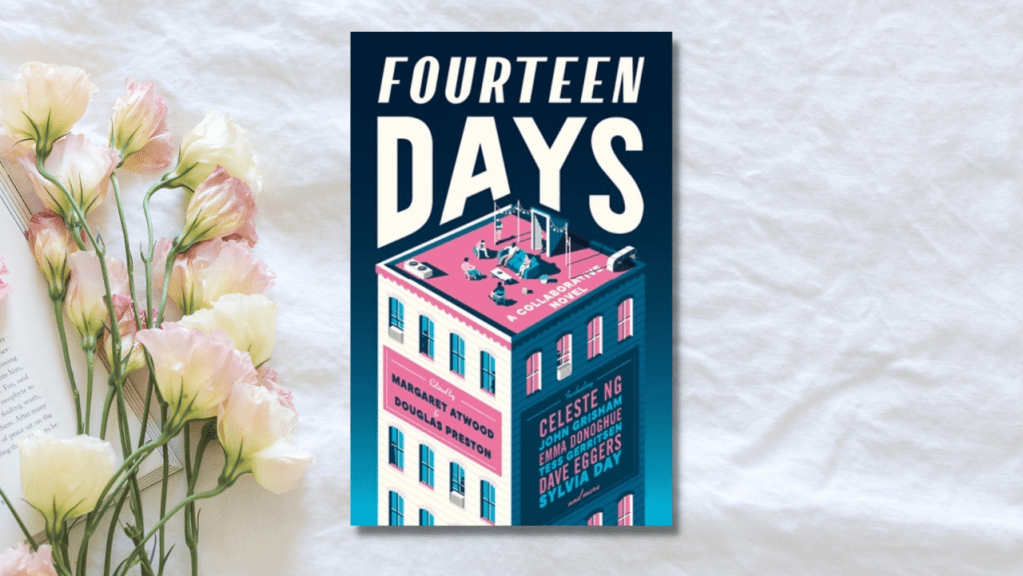
Fourteen days: the period over which our novel unfolds, as the tenants of one run-down New York apartment block gather (with social distancing!) each evening on the rooftop, in the early days of the Covid-19 pandemic, to cheer on the frontline workers and then share, and listen to, stories drawn from their own experience. We aren’t given forenames but each tenant is referred to by a nickname designated by the previous superintendent: Tango, Hello Kitty, La Cocinera, Eurovision and so on… making them at once defined by something in their life, but also somehow anonymous. There are love stories, stories involving crimes, simple stories, outrageous stories, humorous stories, strange stories, surreal stories, deeply sad stories, and everything in between. Are they all even real stories? Does it matter? At a time of uncertainty, fear, mistrust, and isolation, this novel embodies the power of storytelling to both unite and transport; to provide a form of escapism when it’s needed; to see existence through the plights of others at a time of universal struggle; to assert the vitality of humanity in the face of an unpredictable virus; and together to make sense of what it is to be human when nothing around us makes much sense anymore.
There is a lot going on in this book. There are a lot of characters, a lot of voices, a lot of stories within the story, a lot of evolving exchanges between the characters on the rooftop in between the stories; and add to this our narrator, the building’s superintendent, who reflects on her own backstory and expresses the worry she is feeling about being separated from her elderly father, cocooned elsewhere in a nursing home. Here’s the unique twist: this novel is brought to you through a collaboration of 36 American and Canadian authors, who have each contributed to give us one of the tenants’ stories; but we don’t know who wrote which story until the end. With highly recognisable names such as Margaret Atwood (co-editor of the book along with Doug Preston), Celeste Ng, John Grisham, Emma Donoghue and Tommy Orange amongst the contributors, this all comes together as an expansive tapestry of stories within a story, reaching far and wide from one contained rooftop space. If the stories jump wildly from one kind of story to another, from one time, place and culture to another, creating a meandering and at times disjointed feeling, this is countered and centred to a certain extent as one story is often inspired in some way by the story that preceded it, or the conversation sparked between the tenants by the last story. We also see an evolution in the dynamic between the tenants as they begin to open up and get to know each other better, which adds an element of fluidity and progression to the novel.
As said, this book is a lot – how could it not be with such a diverse mix of voices behind it – but it does all come together in the end in quite the finale. A literary exquisite corpse of sorts, and a unique capture of the early pandemic, as I progressed through it I found my rhythm with it and enjoyed it overall.
***
Fourteen Days is published by Vintage on February 6th. Thank you to the publisher and NetGalley for my eARC.
 The Resting Willow