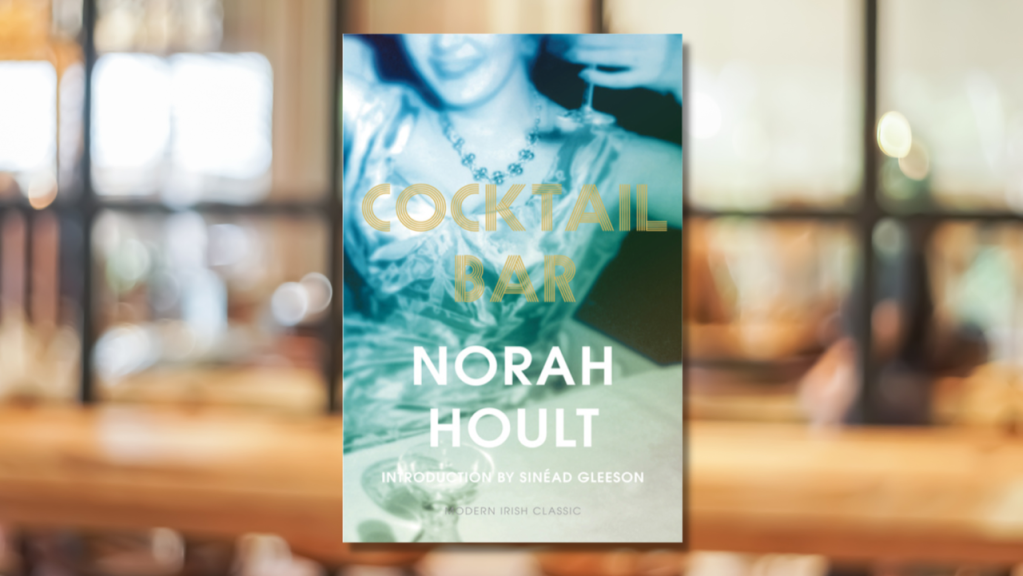
Cocktail Bar by Norah Hoult is a collection of short stories first published in 1950 and, while the language, and social and historical references, sometimes clearly place this in times gone by, there are aspects of the social commentary, and meditations on young love and community dynamics, that could be much more recent. And this is something touched on in author Sinéad Gleeson’s introduction, that Hoult was in fact well ahead of her time; writing about issues that, while perhaps quite normal literary material today, would have been alarming back in the day. Gleeson’s introduction paints a picture of a woman who was independent and not afraid of writing her mind, with some of her books even being banned by the Irish censorship board for dealing with contentious subjects (contentious being for example religion, sexuality, the economy, and the cultural experience of being a woman in 20th century Britain and Ireland). Hoult went to school in England, before moving between Dublin, New York and London in her adult years; this collection was written in London, allowing her the space to contemplate Irish society of the time from afar.
The stories contain observations of class, family, community dynamics, relationships, emigration, mental illness, and of the expectations placed on women of the time, by others and by themselves; all these observations are delivered laced with wit and humour. Hoult has a delightful way of capturing social conduct, little grievances and resentments between people, and subjective meditations on what proper conduct should be, from all strata of life.
The opening story ‘Irish Wedding’ recounts the stresses, the mishaps, the jovial and shameful bridal party, the belligerent older generation, and the social etiquette expected at an Irish wedding in London, all set against the backdrop of a sweet young love between the couple being married. In ‘Three People and Jane’ the village gossip and busy-body puts her meeker neighbours under strain time and time again, while in ‘The Rich Man’ the richest man in town’s good intentions are jeopardised by what the never-to-be-pleased community might think. There are wonderfully humorous observations of the mishaps that occur where communication is lacking; the spinster woman of ‘Surplus Week-end’ whose niece visits, thinking her poor old aunt must be in need of company and not realising that her visit is only disrupting the pleasures of a quiet and content existence; the amusingly uppity woman in ‘Observation’ who casts a critical eye on those all around her during a city outing, unaware of the strains her own presence is causing; or the confusion that occurs when a glamorous visitor to a small guesthouse is unable to vocalise a mistake.
A prolific writer, leaving behind 25 novels and four short story collections, I’m delighted there is plenty more of Norah Hoult’s writing out there to discover.
***
Cocktail Bar was first published in 1950 by William Heinemann, and then by New Island in 2018.
***
Born in Dublin in 1898, Norah Hoult was one of Ireland’s most prolific and popular authors of the 20th century, and also one of the most censored in Ireland. Hoult published journalism, novels and short stories. Her first collection, Poor Women! was published in 1928, and Hoult wrote two further collections, Nine Years is a Long Time and Cocktail Bar. Her novels include Time, Gentlemen, Time!, Holy Ireland, Four Women Grow Up, The Last Days of Miss Jenkinson and There Were No Windows, which was reissued by Persephone Books in 2005. Hoult died in Greystones, Co. Wicklow in 1984.
 The Resting Willow